By Donny Zanger · Published · Last updated: · 7 min read
Pressurized Walls Brooklyn: Prices by Neighborhood
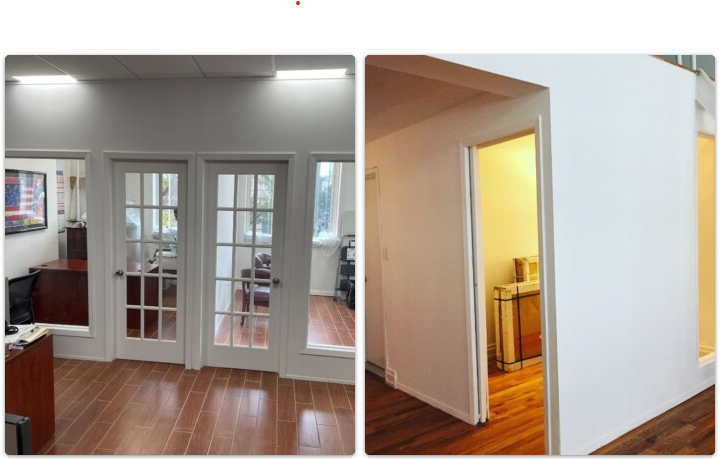
A pressurized wall in Brooklyn starts from $2,250 for a standard floor-to-ceiling wall with a swing door included. This pressurized walls Brooklyn guide breaks down what actually changes that number neighborhood to neighborhood — not the base price, which is the same everywhere, but the add-ons that different building stock tends to trigger. Pre-war buildings with higher ceilings, like the brownstones in Park Slope, often need the ceiling-height add-on that newer 8-foot construction doesn't. We've installed more than 5,000 of these walls across every borough, and Brooklyn is where we do the most work. Here's what drives the price by neighborhood, which landlords say yes fast, and what a typical install week looks like.
Not sure what your Brooklyn apartment would cost?
Call +1 646-569-9975. Most clients get a firm price within the hour.
Call +1 646-569-9975Worried Your Brooklyn Landlord Will Say No?
Most won't. That's not a sales line, it's what we see on the ground. Brooklyn landlords, especially the small independent owners who run buildings in Crown Heights, Bushwick, and Flatbush, approve pressurized walls without much friction. The wall leaves no damage, uses no nails or screws, and the apartment goes back to its original layout when you move out. That's an easy yes for a landlord who just wants the rent paid on time.
Park Slope is a partial exception. Plenty of Park Slope buildings are co-ops or condos with a board, and boards push back more than individual landlords do. A board can say no even when the city has no objection at all. If you're in a Park Slope brownstone with a co-op board, budget an extra week or two for approval, and get that approval in writing before you book an install date.
Pressurized walls are legal in NYC when they meet building code requirements for egress, ventilation, and sprinkler clearance, per the NYC Department of Buildings. We always recommend getting written landlord approval before installation, even in buildings where it isn't strictly required. What we won't tell you is that no permit is ever required, because that depends on your specific building. We also won't tell you your landlord will never notice. Both claims cause problems at move-out, and a company that makes them is setting you up to lose your deposit.
Pressurized Walls Brooklyn Pricing: Neighborhood by Neighborhood
Crown Heights is our highest-volume Brooklyn neighborhood. The pre-war two-bedrooms here have large rooms and high ceilings, which makes them ideal for a split. A standard Crown Heights two-bedroom starts from the $2,250 floor; pre-war units running above 8 feet typically add the 9 ft ($250) or 10 ft ($500) ceiling upgrade on top of that. Landlords here approve quickly, and most jobs book within the same week you call.
Bushwick runs close behind. Apartments here tend to be a mix of converted industrial buildings and standard walk-ups, and both take a pressurized wall well. A Bushwick one-bedroom split into a two-bedroom starts from the same $2,250 floor — and because ceilings here typically run a standard 8 feet, these jobs often need no ceiling add-on at all, which is the main way Bushwick installs tend to land closer to the base price than Park Slope's do. Landlords in Bushwick have generally never had a reason to say no, since so many renters here are already splitting rent with roommates.
Flatbush and the surrounding Ditmas Park and Prospect Lefferts Gardens area see a lot of family-sized apartments getting divided for multi-roommate living. Pricing starts from the same $2,250 floor as everywhere else; the larger rooms common here sometimes push a wall past the 12 ft base width, which adds $190 per additional foot. Approval is straightforward in the private rental buildings that make up most of the housing stock here.
Park Slope tends to run above the $2,250 floor more often than any other Brooklyn neighborhood, not because the base price changes, but because the add-ons that apply here do. The brownstones have 10 to 11-foot ceilings in many units, which triggers the $500 ceiling upgrade more often than not, and the co-op approval process mentioned above can add time even when it doesn't add cost. Renters here are usually splitting a larger apartment rather than a studio, so the room being divided — and sometimes the wall width add-on — tends to be bigger too.
Williamsburg and Bed-Stuy both start from the same $2,250 floor, but the add-ons that typically apply differ. Newer construction in Williamsburg often has standard 8-foot ceilings, so many jobs there need no ceiling add-on at all, while Bed-Stuy's mix of brownstones and walk-ups behaves more like Crown Heights — some units need the ceiling upgrade, some don't.
Brooklyn Pricing at a Glance
Every Brooklyn neighborhood starts from the same $2,250 floor. What typically pushes a job above it depends on the building stock:
Crown Heights: floor, plus ceiling upgrade common in pre-war units
Bushwick: floor, ceiling upgrade rarely needed
Flatbush / Ditmas Park: floor, plus width add-on sometimes needed in larger rooms
Williamsburg / Bed-Stuy: floor, ceiling upgrade depends on the building
Park Slope: floor, plus ceiling upgrade common in brownstones
What Drives the Price Up or Down
Three things push a job above the $2,250 floor. Ceiling height is the one that varies most by neighborhood. The floor covers up to 8 feet; a 9-foot ceiling adds $250, and a 10-foot ceiling adds $500. Brooklyn's pre-war brownstone stock, concentrated in Park Slope, Bed-Stuy, and parts of Crown Heights, often runs 10 to 11 feet, which is why those neighborhoods see the ceiling add-on more often than Bushwick or newer Williamsburg construction does.
Door type is next. A standard swing door is already included in the $2,250 floor. Upgrading to a French door adds $450; a pocket sliding door adds $300; a pocket French door adds $750. Most Brooklyn renters splitting a bedroom for a roommate stick with the included swing door, since it's already a real, closable room at the base price.
Wall width rounds it out. The floor covers up to 12 feet; each additional foot beyond that adds $190. A long Crown Heights living room split down the middle is more likely to cross that 12-foot line than a narrower Bushwick bedroom division, even with the same door and ceiling spec.
Soundproofing is optional on top of all three — a flat $350 regardless of wall size. It's worth it for a home office or a nursery, less necessary for a straightforward roommate bedroom split where some ambient noise isn't a dealbreaker. For the full cost breakdown across every wall configuration citywide, see our complete pressurized wall cost guide for NYC.
What a Brooklyn Install Actually Looks Like
The process is the same across every Brooklyn neighborhood we work in. We measure first, either over the phone with your own dimensions or with an in-person visit for an unusual layout. Materials are cut to your exact room before the crew arrives. Most installs finish in four to eight hours, and a standard wall rarely takes more than one day even with soundproofing added.
Most Brooklyn and Manhattan jobs book within the same week you call, since Brooklyn is where we run the highest volume of our crews. Queens, the Bronx, and Staten Island typically run three to seven days out. If you already have landlord approval in hand, a same-day or next-day install is often possible.
Removal is quoted at the site measure — reasonable notice before your move-out date keeps scheduling simple. Since Brooklyn leases tend to cluster around similar renewal dates, removal requests pick up in the weeks before common move-out periods. If you know when your lease ends, book the removal a few weeks out to avoid the busiest stretch.
For the complete process, pricing, and legality picture in one place, see our pressurized wall installation guide.
Which Brooklyn Situation Are You In?
Most calls we get from Brooklyn fall into three buckets.
If you're splitting rent with a new roommate in a standard rental building, in Crown Heights, Bushwick, or Flatbush, you're in the easiest case. Approval is usually fast, these buildings often need fewer add-ons on top of the floor, and most of these jobs go from first call to finished wall in about a week.
If you're in a Park Slope co-op or condo, plan around the board timeline rather than the installation timeline. The wall itself still takes one day. The approval letter is what adds the extra week or two, so start that conversation with your managing agent before you lock in a moving date.
If you're deciding between a full pressurized wall and a bookcase wall, that's a separate decision worth making before you call anyone. This usually comes up when you're not sure your building will approve a floor-to-ceiling partition. We break down that comparison, along with flex walls, in our full temporary walls NYC comparison guide.
Want the exact number for your Brooklyn apartment? Tell us your neighborhood and room dimensions.
Call +1 646-569-9975Frequently Asked Questions
How much does a pressurized wall cost in Crown Heights?
A standard Crown Heights two-bedroom starts from the $2,250 floor. Pre-war layouts here often run above the standard 8-foot ceiling, which adds the ceiling upgrade — $250 for 9 feet, $500 for 10 feet — the main reason a Crown Heights job tends to land above the floor rather than at it.
Do Park Slope co-op boards allow pressurized walls?
Often, yes, but expect the approval process to take longer than a standard rental building. Because a pressurized wall leaves no permanent damage, most boards approve it once they've reviewed the request in writing. Budget an extra week or two before booking your install date.
Is Bushwick cheaper than the rest of Brooklyn for a pressurized wall?
The base price is the same everywhere — Bushwick isn't a lower floor. What's true is that Bushwick jobs often land closer to that $2,250 floor than Park Slope's do, because ceiling heights here tend to be a standard 8 feet, so the ceiling add-on rarely applies. A Bushwick job with an oversized room or a door upgrade costs the same as an identical job anywhere else in Brooklyn.
How fast can I get a pressurized wall installed in Brooklyn?
Most Brooklyn jobs book within the same week you call, since Brooklyn is where we run our highest crew volume. If you already have written landlord approval, a same-day or next-day install is often possible.
Do I need a permit to install a pressurized wall in a Brooklyn apartment?
No, in most standard rental apartments. Pressurized walls are classified as temporary, non-structural modifications that don't trigger the DOB permit threshold. Co-op and condo buildings may still require their own board approval on top of city rules.
Ready for a Brooklyn Quote?
You know the floor now: $2,250 for every Brooklyn neighborhood, with the ceiling, width, door, and soundproofing add-ons priced separately depending on your specific apartment — not your zip code. Tell us your neighborhood and room dimensions, and we'll give you an exact number.
Call +1 646-569-9975 for a free same-day Brooklyn quote. Most clients get a price within the hour.
Call +1 646-569-9975 Get a Free QuoteAbout the Author: Donny Zanger
Donny Zanger has installed more than 5,000 pressurized walls across Manhattan, Brooklyn, Queens, the Bronx, and Staten Island over more than 15 years. He founded Pressurized Walls NYC to give renters a straight answer on cost, legality, and which wall type actually fits their apartment.
By Donny Zanger · Published · Last updated: · 13 min read
Temporary Walls NYC Comparison: 3 Types Ranked
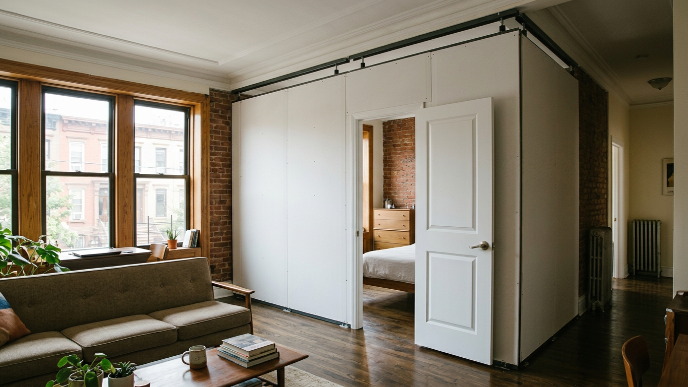
Three types of temporary walls get installed in NYC apartments every week: pressurized, flex, and bookcase. This temporary walls NYC comparison breaks down what each one actually costs and does, starting with the honest version of the numbers: pressurized and flex walls are the same build at the same price, from $2,250 with a standard swing door included, and bookcase walls start higher, from $3,250, in exchange for skipping the landlord conversation entirely. If you're trying to split a one-bedroom in Bushwick with a roommate, or your co-op board on the Upper West Side just said no to a floor-to-ceiling wall, the type you pick matters more than most renters realize. We've installed all three more than 5,000 times across every borough. This guide skips the theory and gets straight to the trade-offs: price, privacy, storage, and which one your landlord is actually likely to approve.
Not sure which wall fits your apartment?
Call +1 646-569-9975. We'll walk you through it in five minutes.
Call +1 646-569-9975Quick Answer
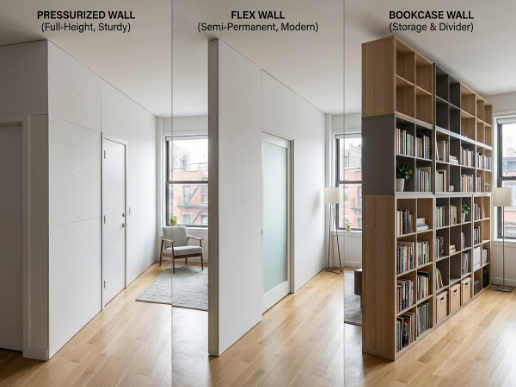
Pressurized wall: From $2,250. Floor to ceiling. Includes a door. Best privacy and sound blocking.
Flex wall: From $2,250. Same build and price as pressurized — a different name for the same product, not a separate finish tier.
Bookcase wall: From $3,250. Stops short of the ceiling. Adds storage. Usually skips landlord approval.
Worried Your Landlord Will Say No? Here's What Actually Happens
That's the real question behind almost every one of these calls. You've found the apartment. The layout works if you add a wall. The only thing standing between you and signing the lease is whether your landlord, or your co-op board, will let you.
Here's the honest answer. Pressurized and flex walls are legal in NYC when they meet building code requirements for egress, ventilation, and sprinkler clearance. Most standard rental landlords in Brooklyn, Queens, and the Bronx approve them without a fight. Co-op boards on the Upper East Side and in pre-war Manhattan buildings push back more often, mostly because a floor-to-ceiling wall changes the apartment's footprint in a way board members want to see in writing first.
Bookcase walls sidestep a lot of that friction. Because a bookcase wall is built and installed as freestanding furniture rather than an architectural change, most NYC leases don't require landlord approval for one at all. If your building has already said no to a pressurized wall, a bookcase wall is usually the fallback that gets you to yes.
We always recommend getting written approval from your landlord before installation, even when it isn't strictly required. It protects your deposit and it protects the relationship. What we won't tell you is that a permit is never required for any of these walls, because that depends on your specific building and project, or that your landlord will never notice. Neither claim holds up, and a company that tells you otherwise is setting you up for a problem at move-out.
For the full building-code breakdown, the NYC Department of Buildings publishes the egress and ventilation rules that govern any interior partition.
Pressurized Walls: The Standard NYC Choice
A pressurized wall is a floor-to-ceiling partition that locks between your ceiling and floor using internal pressure instead of nails, screws, or adhesive. Once it's up, it looks and functions like a real drywall wall, complete with a door. This is the wall most renters mean when they say "temporary wall" without specifying further.
Pricing starts from $2,250, which already includes a standard swing door, up to 12 feet wide and an 8-foot ceiling. From there, real upgrades are priced separately: a French door adds $450, a pocket sliding door adds $300, a pocket French door adds $750. A 9-foot ceiling adds $250, a 10-foot ceiling adds $500. Extra width beyond 12 feet adds $190 per foot. Soundproofing is a flat $350 on top of any of that.
What you get for that money is real privacy. Sound and light don't pass through a pressurized wall the way they do through a bookcase wall's open shelving. If you're creating a bedroom you plan to list on a roommate app, or you just need a door you can close at 11 p.m. after a long day, this is the type built for that.
The trade-off is timeline and reversibility expectations. Installation still takes one day, four to eight hours in most apartments, and removal is quoted at the site measure when your lease ends. But because it's a true floor-to-ceiling structure, it's the option most likely to need a landlord conversation first.
For a full walkthrough of the process and pricing variables, see our pressurized wall installation guide.
Flex Walls: Same Wall, Different Name
Here's the straight answer, because renters searching both terms deserve it: a flex wall and a pressurized wall are the same build, at the same price, from the same $2,250 floor. "Flex wall" and "pressurized wall" are two names for the same pressure-fit technology — not a budget option and a premium option. If a search result or another company implies flex walls cost more for a nicer finish, that's not how we price them, and it's not how the underlying product differs either.
So why do both terms exist? Mostly because renters search for both, and both searches deserve a straight answer rather than being redirected without explanation. If you've read this far wondering whether you need to choose between "flex" and "pressurized" for your own apartment, the answer is: you don't. Pick whichever term matches how you were searching — the wall, the price, and the installation process are identical either way.
We break this down in more detail in our flex wall vs. pressurized wall guide.
Bookcase Walls: Storage Plus Privacy, No Landlord Fight
A bookcase wall divides a room the same way a pressurized wall does, except one side of the divider holds open shelving instead of finishing flush like a drywall panel. It's built as a freestanding piece of furniture, which is exactly why it rarely triggers a landlord approval process.
Pricing starts from $3,250 — the highest floor of the three wall types, since a bookcase wall is a more complex build than a straight partition. What you're paying for isn't a lower price; it's skipping the landlord conversation and getting built-in storage in the same job. In a Harlem studio or a Bronx one-bedroom where closet space is already tight, that built-in storage does real work.
The trade-off is at the top of the wall. A bookcase wall stops a few inches below the ceiling, so there's always a gap. Sound travels through that gap, and light passes through the open shelves. You get visual privacy, not acoustic privacy. That makes a bookcase wall a strong studio divider and a weaker choice if you're trying to create a bedroom for a roommate who works overnight shifts and sleeps during the day.
See our full bookcase wall vs. pressurized wall breakdown for a side-by-side on cost and privacy.
What About Room Dividers and Accordion Walls?
Two other terms come up in the same searches, so it's worth separating them out. A room divider, in the generic sense, usually means a curtain, screen, or freestanding panel that offers visual privacy only. It costs significantly less than any of the three walls above, since it's an off-the-shelf or low-cost product rather than a custom installation. But it doesn't reach the ceiling, doesn't block sound, and won't hold up to a landlord asking whether you've made a real change to the apartment. An accordion wall is a folding, track-mounted partition. It's more common in commercial buildouts and offices than residential apartments, since it needs a header track installed. It also doesn't offer the same finished look as a pressurized or bookcase wall. For a real bedroom or private office in an NYC apartment, the room-divider-vs-pressurized-wall comparison isn't close. A room divider is a stopgap, not a solution. Most renters who start there end up calling us within a few months anyway, once the lack of real privacy becomes a daily annoyance.
How Installation Day Actually Works
The process is the same across all three wall types, which is part of why the price difference comes down to materials and finish rather than labor complexity.
We measure. This can happen over the phone with your own dimensions, or with an in-person visit if the room has an unusual layout, an angled wall, or existing molding we need to work around.
We build and install. Materials are cut to your exact dimensions before the crew arrives, so the on-site work is assembly and fitting, not construction. Most installs finish in four to eight hours, and a single pressurized or flex wall rarely runs past one day even with a soundproofing add-on. Bookcase walls, since they're assembled as furniture, can sometimes go faster.
You move in. There's no drying time, no dust to clean up, and no waiting period before you can hang art, mount a TV, or push a bed frame against the new wall. A pressurized or flex wall supports light wall-mounted items once installed; check with your installer before mounting anything heavier than a shelf.
When it's time to move out, removal is quoted at the site measure on all three wall types. Because most NYC leases run on a similar annual cycle, removal requests cluster heavily in the weeks before common move-out dates. If you already know when your lease ends, booking your removal a few weeks ahead keeps you off the waitlist during the busiest stretch of the year.
A Real Example: Same Apartment, Two Real Answers
Picture a two-bedroom conversion in a Crown Heights brownstone, splitting the living room to create a third bedroom for a roommate. If the goal is a private bedroom with a real door, a pressurized wall (call it flex if that's the term you searched — same wall, same price) gets it done in a day. The landlord, a small independent owner rather than a board, approves it after a short phone call. Now picture the same apartment inside a managed building on the Upper West Side with a stricter co-op board. A bookcase wall gets the group into the space faster, since it skips the board approval process entirely — the pressurized-wall alternative would work through the board's timeline in the background instead.
Neither answer is wrong. They're optimized for different constraints: full privacy at the lower price, or a faster path to approval plus storage at the higher one. That's the whole decision in miniature.
Mixed households come up often, too. A four-bedroom share in Jackson Heights might end up with two pressurized walls for the bedrooms that need real doors. The living room might get a bookcase wall instead, dividing off a nook for a roommate who mostly needs a place to work from home. There's no rule that says every wall in an apartment has to match. We quote each one on its own, based on what that specific space needs.
Every quote we send breaks the price down by wall type and by room, so a mixed installation doesn't come as a surprise on the invoice.
Temporary Walls NYC Comparison Table: All Three Types Side by Side
Here's the full breakdown in one place. Pressurized and flex are listed separately since renters search both terms, but every row is identical between them — they're the same wall.
| Pressurized wall | Flex wall | Bookcase wall | |
|---|---|---|---|
| Price | From $2,250 | From $2,250 | From $3,250 |
| Reaches ceiling | Yes | Yes | No — gap at top |
| Door included | Yes, standard swing (upgrades available) | Yes, standard swing (upgrades available) | No — open access |
| Sound blocking | Strong | Strong | Weak |
| Built-in storage | No | No | Yes |
| Landlord approval typically needed | Yes | Yes | Usually not |
Want the exact number for your apartment? Tell us your room dimensions and we'll send a price before end of day.
Call +1 646-569-9975Which One Should You Get?
We'll make the call instead of leaving you to guess, because that's what fifteen years of doing this is for.
If privacy is the deciding factor, meaning you need a real bedroom door and you don't want sound leaking through, get a pressurized wall — call it flex if that's what you searched, it's the same wall at the same price. It's the cheaper of the two floors, and it gives you full floor-to-ceiling separation with a real door.
If your landlord already said no to a floor-to-ceiling wall, or you know your building is strict, go with a bookcase wall before you spend time fighting that battle. It starts $1,000 higher than a pressurized wall, but you're paying for skipping the approval process entirely, plus built-in storage. You'll still get privacy from a casual glance.
If storage is genuinely your bigger problem, meaning your apartment doesn't have enough closet or shelf space regardless of the wall question, the bookcase wall is worth the higher floor even in buildings that would approve a pressurized wall without issue.
Most NYC renters end up choosing between a pressurized wall and a bookcase wall. Those two cover the two real priorities: full privacy at the lower price, or easier approval plus storage at the higher one. "Flex wall" isn't a third option — it's the same product as pressurized, so whichever term you search, you'll land on the same wall.
What About Soundproofing?
All three wall types can add soundproofing, typically mineral wool insulation, for a flat $350. This closes most of the remaining sound gap on a pressurized or flex wall and gets you close to what a standard interior apartment wall blocks. On a bookcase wall, soundproofing helps less, since the open shelving at the top still lets sound through no matter what's inside the wall itself. If acoustic privacy is your main concern, put the soundproofing budget toward a pressurized or flex wall instead of a bookcase wall.
Frequently Asked Questions
Which is cheaper, a pressurized wall or a bookcase wall?
A pressurized wall, starting from $2,250. A bookcase wall starts from $3,250 — $1,000 higher — because it's a more complex build. The bookcase wall's price covers skipping the landlord approval process and getting built-in storage, not a lower cost.
Do I need landlord approval for a bookcase wall?
No, in most standard NYC leases. Because a bookcase wall is installed as freestanding furniture rather than an architectural change, it typically doesn't require the same landlord sign-off a floor-to-ceiling pressurized or flex wall does. We still recommend telling your landlord before installation.
What's the actual difference between a flex wall and a pressurized wall?
None. They're the same pressure-fit build at the same price, from $2,250. "Flex wall" and "pressurized wall" are two names renters search for the same product — not a budget tier and a premium tier.
Are temporary walls legal in NYC?
Yes, pressurized, flex, and bookcase walls are all legal in NYC when they meet building code requirements for egress, ventilation, and sprinkler clearance. Co-op and condo boards can still set their own approval process on top of that, separate from city code.
How long does installation take for each type?
All three types are typically installed in one day, usually four to eight hours depending on wall size and finish level. Removal is quoted at the site measure for every type and leaves no damage to floors, ceilings, or walls.
Can I combine wall types, like a bookcase wall for one room and a pressurized wall for another?
Yes. Plenty of NYC apartments end up with a mix, especially in larger shares where one bedroom needs full acoustic privacy and another is more of a home-office nook where storage matters more than soundproofing. We quote each wall separately, so there's no penalty for mixing types in the same apartment.
Will a temporary wall lower my apartment's resale or rental value when I move out?
No, as long as removal is done properly. Because all three wall types are designed to come down without damaging the underlying floors, ceilings, or walls, the apartment returns to its original layout. That's the entire point of choosing a temporary wall over a permanent renovation in the first place.
Ready to Pick the Right Wall for Your Apartment?
You've got the trade-offs now: pressurized (or flex — same wall) for privacy at the lower price, bookcase for storage and an easier approval process at the higher one. If you're still not sure which one fits your specific layout, that's exactly what a same-day quote is for. Tell us your room dimensions and your building type, and we'll tell you which wall makes sense before you spend another night scrolling Zillow.
Call +1 646-569-9975 for a free same-day quote. Most clients get a price within the hour.
Call +1 646-569-9975 Get a Free QuoteAbout the Author: Donny Zanger
Donny Zanger has installed more than 5,000 temporary walls across Manhattan, Brooklyn, Queens, the Bronx, and Staten Island over more than 15 years. He founded Pressurized Walls NYC to give renters a straight answer on cost, legality, and which wall type actually fits their apartment.
Flex Wall vs Pressurized Wall NYC: Is There Really a Difference?
By Donny Zanger · · Last updated: · 7 min read
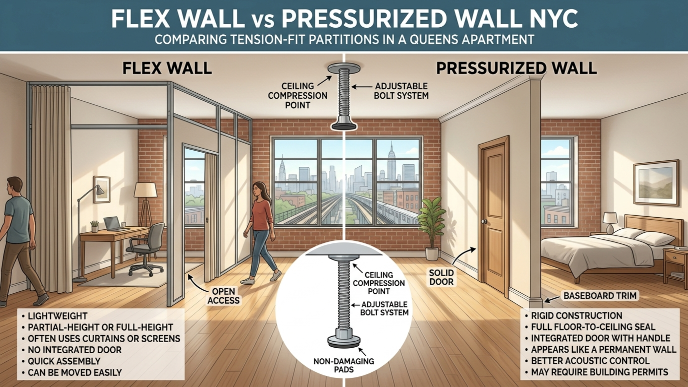
A flex wall vs pressurized wall NYC comparison usually turns up the same answer most renters do not expect: at Pressurized Walls NYC, they are the same product, priced the same way, starting from $2,250 with a standard swing door included, before add-ons for door upgrades, ceiling height, extra width, or soundproofing. The difference most people are searching for does not actually exist here, and pretending otherwise would waste your time.
What does exist is real confusion across the industry, because some NYC companies use "flex wall" as an umbrella term covering several partition types, while others use it as a synonym for "pressurized wall." Donny Zanger, who has installed more than 5,000 of these walls across all five boroughs over 15+ years, breaks down exactly where that confusion comes from below, plus when the name genuinely does matter for your decision.
Not sure which wall type fits your apartment? Call +1 646-569-9975 and we will walk through it with you for free.
Get a Quote for Either TypeFlex Wall vs. Pressurized Wall: Is There Actually a Difference?
At Pressurized Walls NYC, no. A flex wall and a pressurized wall are the same floor-to-ceiling partition, held in place by internal tension against your existing floor and ceiling instead of nails, screws, or adhesive. We confirmed this directly in our own guide to pressurized wall legality, which states plainly that the two terms describe the same product under NYC building code.
That means the cost is the same, the installation process is the same, and the landlord conversation is the same. If a company tells you a "flex wall" is a different, cheaper, or more flexible product than a "pressurized wall," ask them to explain the structural difference. In our experience, there usually is not one.
Where the Flex Wall vs. Pressurized Wall Confusion Comes From
The confusion exists because the wall industry never agreed on consistent terminology. Some NYC companies use "flex wall" as a category label that includes pressurized walls, bookcase walls, and sliding partitions, almost like "temporary wall" is used elsewhere. Other companies, including Pressurized Walls NYC, use "flex wall" and "pressurized wall" as direct synonyms for one specific product.
As a result, a renter in Astoria comparing two quotes might see "flex wall: $2,250" from one company and "pressurized wall: $2,250" from another, and assume they are different products simply because the words are different. They are not, at least not here. The safest move is to ask any installer directly: does this wall attach using pressure, with no nails or screws? If yes, you are looking at the same underlying product no matter what it is called.
How to Confirm You’re Comparing the Same Wall, Not Different Products
Before you assume a flex wall vs pressurized wall NYC quote represents two different products, ask the installer four questions: How does the wall attach to my floor and ceiling? What finish options are included at this price? Is soundproofing built in or an upsell? What warranty comes with the installation? If two companies give you matching answers but different names, you are paying for the same wall twice in your head, not in your wallet.
We've seen this play out in real quotes: two installers describing the same tension-fit, no-nails attachment method and the same finish options, one calling it a "flex wall" and the other a "pressurized wall," with the price landing wherever that installer's pricing happens to sit — not determined by which name is on the invoice. Comparing the construction details, not the label, is the only way to know if you are getting a fair price.
Cost Comparison: Flex Wall vs. Pressurized Wall
Because the two terms describe the same product at Pressurized Walls NYC, the pricing below has only one column that matters: cost by what's actually in the wall, not by name.
| What's included | Price | Flex Wall or Pressurized Wall? |
|---|---|---|
| Base wall, up to 12 ft wide, 8 ft ceiling, standard swing door | From $2,250 | Same product, either name |
| + French door upgrade | + $450 | Same add-on, either name |
| + Pocket sliding door upgrade | + $300 | Same add-on, either name |
| + 10 ft ceiling | + $500 | Same add-on, either name |
| + Soundproofing | + $350 | Same add-on, either name |
For the full breakdown of what drives those numbers up or down, see our complete pressurized wall cost guide for NYC.
Flex Wall Installation NYC: Cost & Process (2026 Guide) The full install walkthrough — measuring, scheduling, and what installation day actually looks like.Will My Landlord Treat a Flex Wall Differently Than a Pressurized Wall?
No, and this is exactly why the naming confusion matters less than it seems. Since a flex wall and a pressurized wall are the same structure, the same landlord conversation applies to both. Most buildings and co-op boards approve them because neither version causes permanent damage.
Pressurized walls, regardless of which name your installer uses, are legal in NYC when they meet NYC Department of Buildings requirements for egress, ventilation, and sprinkler clearance. We still recommend getting written approval from your landlord before installation, no matter which name appears on the invoice. We never suggest installing without telling your landlord, since that creates real risk for you later.
Want a same-day quote without worrying about which name to search for? Tell us your room dimensions and door preference and we will give you a number today.
Call +1 646-569-9975Flex Wall (Pressurized Wall) vs. Bookcase Wall: When the Name Actually Matters
Here is where a real comparison exists. A flex wall, also called a pressurized wall, gives you a true room-like partition with privacy close to a permanent wall. A bookcase wall trades some of that privacy for built-in shelving, since the storage side faces into your existing room.
Renters in Crown Heights and Bushwick converting a one-bedroom for a roommate usually choose a flex or pressurized wall, because they want the room to feel real. Renters who are short on storage in a smaller Upper East Side or Jackson Heights apartment sometimes choose the bookcase option instead, because the shelving doubles as furniture they would have bought anyway. We compare both directly in bookcase wall vs. pressurized wall.
Which Should You Choose for Your NYC Apartment?
Stop comparing flex walls to pressurized walls as if they are competing products, because at Pressurized Walls NYC, they are not. Instead, decide based on what you actually need: full privacy and a real bedroom feel, or storage plus partial privacy.
If you want a real second bedroom in a Brooklyn or Queens one-bedroom, book a standard flex or pressurized wall with a hinged or French door. If storage is your bigger problem, look at the bookcase comparison above before you book anything. Either way, the name on the invoice should not change the price or the legal conversation with your landlord.
Whether you landed here searching flex wall vs pressurized wall NYC pricing or just comparing two contractor quotes, the installation timeline does not change based on the label either. Most single-room jobs take four to eight hours and rarely run past one day, and removal at the end of a lease typically takes a few hours with no damage to the original walls, floor, or ceiling.
For the full picture, including where a bookcase wall fits alongside these two, see our complete temporary walls NYC comparison covering pressurized, flex, and bookcase walls side by side.
Frequently Asked Questions
Is a flex wall the same as a pressurized wall?
In almost every case, yes. A flex wall and a pressurized wall both describe a floor-to-ceiling partition held in place by internal pressure instead of nails or screws. Most NYC wall companies, including Pressurized Walls NYC, use the two terms interchangeably for the same product.
If they're the same thing, why does my search show comparison articles calling them different?
Some companies use "flex wall" as a broader category that includes pressurized walls, bookcase walls, and sliding partitions, while using "pressurized wall" to mean only the standard tension-fit type. That inconsistency across the industry is where the confusion comes from, not a real product difference at Pressurized Walls NYC.
Does a flex wall cost more or less than a pressurized wall?
Since they are the same product at Pressurized Walls NYC, the price is identical: from $2,250, with the same add-ons (door upgrades, ceiling height, soundproofing) priced the same way regardless of which name is on the quote. There is no separate "flex wall price" to compare against.
Do I need separate landlord approval for a flex wall versus a pressurized wall?
No. Because they are the same physical structure, the same landlord conversation and the same NYC building code rules for egress, ventilation, and sprinkler clearance apply to both.
Should I get a flex wall or a bookcase wall instead?
Choose a flex or pressurized wall if you want the look and privacy of a real bedroom wall. Choose a bookcase wall if built-in storage matters more to you than a true room-like feel, since it trades some privacy for shelving.
How long does installation take for a flex wall or pressurized wall?
Most single-room flex wall or pressurized wall installations in NYC take four to eight hours and rarely run past one day. Removal at the end of your lease typically takes a few hours with no damage to your apartment's original walls, floor, or ceiling.
Ready to book, no matter what you call it?
Call +1 646-569-9975 for a free same-day quote, or get a price online. We install in Brooklyn, Queens, Manhattan, the Bronx, Staten Island, Hoboken, and Jersey City.
Get a Quote for Either TypeDonny Zanger
Donny Zanger has installed pressurized and flex walls across NYC for 15+ years and has personally overseen 5,000+ installations in Brooklyn, Queens, Manhattan, the Bronx, Staten Island, and Hoboken. He founded Pressurized Walls NYC to give renters a straight answer on cost, legality, and which wall type actually fits their apartment. pressurizedwallsnyc.com | +1 646-569-9975
Pressurized Wall Cost NYC: The 2026 Pricing Breakdown
By Donny Zanger · · Last updated: · 8 min read
Pressurized wall cost NYC starts from $2,250 in 2026, which already includes a standard swing door up to 12 feet wide and an 8-foot ceiling. That floor covers a basic single-door wall in a Bushwick studio; a seamless, soundproofed configuration in a pre-war Upper West Side apartment costs more once the real add-ons — door upgrades, ceiling height, extra width, soundproofing — are priced in. Most renters splitting a one-bedroom in Brooklyn or Queens land at or close to the floor once a standard door is included, since that door is already part of the base price.
If you are trying to figure out whether a pressurized wall fits your budget, or whether the price you were quoted by another company actually makes sense, this breakdown covers every variable that moves the number up or down. Donny Zanger and his crew have priced and installed more than 5,000 of these walls across all five boroughs over the last 15+ years, so the ranges below come from real jobs, not a rate card someone wrote once and never updated.
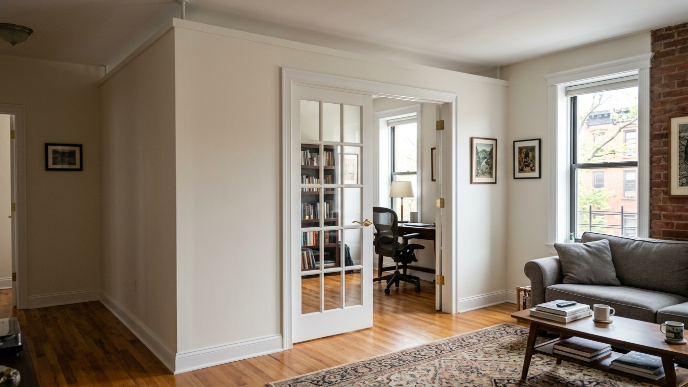
Want a number for your exact apartment instead of a range? Call +1 646-569-9975 for a free same-day quote.
Get Your Free QuoteWhat Determines Pressurized Wall Cost in NYC?
Four things drive pressurized wall cost in NYC up or down: wall width, ceiling height, door type, and soundproofing. Wall width matters because the floor only covers up to 12 feet — each additional foot adds $190. A 10-foot wall across a studio stays at the floor; a wider wall crossing a full living room adds up per foot beyond that.
Door type is the second-biggest factor. A standard hinged door is already included in the $2,250 floor. A French door adds $450, a pocket sliding door adds $300, and a pocket French door adds $750 — flat add-ons, not a sliding scale based on wall size.
Ceiling height and soundproofing round out the list. The floor covers up to 8 feet; a 9-foot ceiling adds $250, and a 10-foot ceiling adds $500. Soundproofing is a flat $350 on top of any configuration. As a result, two walls of identical size can have very different final prices once door upgrades, ceiling height, and soundproofing are factored in.
Pressurized Wall Cost by Configuration
Here is how pressurized wall cost NYC actually breaks down — one floor, plus flat add-ons, not a sliding scale.
| What's included | Price | Best For |
|---|---|---|
| Base wall, up to 12 ft wide, 8 ft ceiling, standard swing door | From $2,250 | Studios, small one-bedrooms |
| + French door upgrade | + $450 | Two-bedroom splits |
| + Pocket sliding door upgrade | + $300 | Tight hallways, small footprints |
| + 10 ft ceiling upgrade | + $500 | Pre-war apartments, lofts |
| + Soundproofing | + $350 | Home offices, light sleepers |
These figures hold across the city — the floor and every add-on above are the same in every borough. An L-shaped or corner configuration is priced individually rather than off a published figure; ask for a quote if your layout isn't a straight wall.
How Neighborhood and Apartment Type Affect Price
A pressurized wall in a Crown Heights brownstone with 9-foot ceilings costs $250 more than the same wall in a standard 8-foot Astoria one-bedroom, simply because the ceiling upgrade applies. Similarly, a SoHo loft with exposed brick and uneven walls often needs custom shimming, which is priced individually rather than off a published add-on.
In contrast, a straightforward studio in Jackson Heights or Flatbush usually lands right at the $2,250 floor because the layout is simple and the ceiling height is standard. For a neighborhood-by-neighborhood breakdown of which Brooklyn building stock tends to trigger which add-ons, see our Brooklyn pricing guide.
Across all five boroughs, plus Hoboken and Jersey City, the same floor and the same add-ons apply. The number changes based on your apartment, not your zip code.
Pressurized Wall Cost: Studio vs. One-Bedroom vs. Two-Bedroom
Apartment type changes the math because it changes where the wall goes and how much of the room it has to span. A studio conversion usually needs one wall, often with the standard swing door already included in the base price, which is why studio jobs tend to land right at the $2,250 floor.
A one-bedroom split into a two-bedroom is the most common job we run, and it usually calls for a French or sliding door upgrade for privacy — $2,550 with the pocket sliding upgrade, $2,700 with French doors, more if a ceiling upgrade also applies. Two-bedroom-to-three-bedroom conversions, which we see often in larger Midtown and Harlem apartments, sometimes need two walls instead of one — since each wall is priced from its own $2,250 floor, that's the main reason those jobs cost more, not a bigger range on a single wall.
Will My Landlord Charge Me for This, and Is Removal Included?
A lot of renters assume a pressurized wall is going to cost them their security deposit, either because the landlord finds out or because removal turns into a surprise bill. Here is the honest answer: removal is quoted at the site measure, and when you move out, the wall comes down the same way it went up, using internal pressure instead of nails or screws.
As for your landlord, most buildings and co-op boards approve pressurized walls because they cause zero permanent damage. We still recommend getting written approval before installation. Pressurized walls are legal in NYC when they meet NYC Department of Buildings requirements for egress, ventilation, and sprinkler clearance, and you can read the full breakdown of those rules in our guide to pressurized wall legality in NYC. We never suggest hiding a wall from a landlord, because that creates real risk for you down the line.
Hidden Fees to Watch For From Other NYC Wall Companies
Not every company prices pressurized walls the same honest way. Some quote a low base price, then add the door, the finish, and the removal as separate line items once you are already committed. That practice is exactly why the pressurized wall cost NYC range above already includes the door and the finish, not just the bare frame.
Before you book with anyone, ask directly whether the quoted number includes the door and whether removal is a separate line item. Getting those two answers in writing before you commit is the real protection against a surprise bill.
Why Professional Installation Costs More Than a DIY Kit — and Why That Matters
You can find cheaper DIY pressurized wall kits online, but we recommend against them for most NYC apartments. A kit that is not custom-fit to your exact ceiling height and wall irregularities can shift, sag, or fail to meet the building code clearances that protect you from a landlord dispute.
Professional installation costs more because a trained installer measures your space precisely, accounts for uneven pre-war ceilings, and builds the wall to meet egress and sprinkler clearance on the first try. For a one-time investment that needs to satisfy a landlord or co-op board, the extra cost is the safer choice.
If you want the exact cost for your apartment instead of an estimate, give us your room dimensions and door preference. We give free quotes the same day, most within the hour.
Call +1 646-569-9975How Pressurized Wall Cost Compares to Other Wall Types
Pressurized walls usually cost about the same as flex walls in NYC, because in most cases, they are the same product under two different names. If you want the full explanation of where that naming confusion comes from and when it actually matters, we break it down in flex wall vs. pressurized wall in NYC.
Bookcase walls start higher, from $3,250, but you are paying for built-in storage along with skipping the landlord approval process entirely. We compare both directly in bookcase wall vs. pressurized wall, including which one makes sense if storage matters more than a true room-like feel.
Does Pressurized Wall Pricing Change With the Season?
Pressurized wall cost NYC stays fairly stable year-round, but scheduling does not. Move-in season, roughly May through September, is when most leases turn over across Brooklyn, Queens, and Manhattan. Consequently, booking two to three weeks ahead during those months gets you a faster installation date, while a January or February call often means next-day availability.
In other words, the price will not jump because it is August. Your timeline might, simply because more renters are converting one-bedrooms into two-bedrooms at the same time of year.
How to Get an Accurate Quote for Your Apartment
Getting an accurate number takes three steps. First, measure the width and ceiling height of the space where the wall will go. Second, decide on a door type, since that single choice can shift the price by several hundred dollars. Third, call or text your dimensions to +1 646-569-9975, and you will get a firm quote before we schedule an on-site visit.
For a full walkthrough of what installation day actually looks like, see our complete pressurized wall installation guide for NYC, which covers the process from measurement to move-in. Most installs are finished in four to eight hours, so you can typically book a job and sleep in your new room the same week.
Frequently Asked Questions
How much does a pressurized wall cost in NYC?
A pressurized wall in NYC starts from $2,250 in 2026, which already includes a standard swing door. The price goes up from there based mainly on door upgrades, ceiling height, extra width, and whether you add soundproofing.
Is wall removal included in the price, or is there a separate fee?
Removal is quoted at the site measure. When you move out, the wall comes down the same way it went up, using internal pressure instead of nails or screws.
Does adding soundproofing increase the cost of a pressurized wall?
Yes, soundproofing is a flat $350 add-on regardless of wall size. Most renters who work from home or want a quieter bedroom find it worth the extra cost.
Why does the price go up from the $2,250 floor?
It's not a sliding scale — it's a flat floor plus flat add-ons. A basic single-door wall stays at $2,250. Door upgrades add a fixed amount depending on which one you pick: $300 for a pocket sliding door, $450 for a French door, or $750 for a pocket French door. A taller ceiling adds $250 for 9 feet or $500 for 10 feet. Extra width beyond 12 feet adds $190 per foot, and soundproofing adds a flat $350. Two walls can land at very different final prices, but every dollar of that difference traces back to a specific, named add-on, not a vague size-and-scope estimate.
How fast can I get an accurate price quote for my apartment?
Most renters get a price the same day they call. Pressurized Walls NYC asks for room dimensions, ceiling height, and your preferred door type, then gives a firm number before scheduling an on-site visit.
Is the quoted price the final price, or are there extra fees later?
The number we quote after hearing your dimensions and door preference is the number you pay, with any add-ons (door upgrade, ceiling height, soundproofing) itemized upfront, not added as a surprise once you're committed. Removal is quoted separately at the site measure.
Ready to find out what your wall will actually cost?
Call +1 646-569-9975 for a free same-day quote, or get a price online. We install in Brooklyn, Queens, Manhattan, the Bronx, Staten Island, Hoboken, and Jersey City.
Get Your Same-Day QuoteDonny Zanger
Donny Zanger has installed pressurized walls across NYC for 15+ years and has personally overseen 5,000+ installations in Brooklyn, Queens, Manhattan, the Bronx, Staten Island, and Hoboken. He founded Pressurized Walls NYC to give renters a straight answer on cost, legality, and which wall type actually fits their apartment. pressurizedwallsnyc.com | +1 646-569-9975
By Donny Zanger | | Updated:
Pressurized Wall Installation NYC: Complete 2026 Guide
Pressurized wall installation in NYC starts from $2,250, which already includes a standard swing door up to 12 feet wide and an 8-foot ceiling. Installation takes one day — usually 4 to 8 hours. Your apartment goes back to its original condition when you leave because these walls use no nails, no screws, and no glue. If you're splitting a bedroom, adding a home office, or making a studio work for two people, here's everything you need to know before you call.
We've handled pressurized wall installations across NYC for over 15 years — 5,000+ walls in Brooklyn apartments, Manhattan studios, Bronx two-bedrooms, and Queens co-ops. This guide covers the full process: cost breakdown, what happens on install day, landlord questions, and how to get a same-day quote.
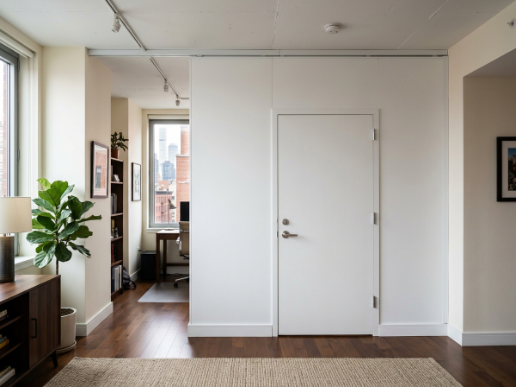
How Much Does Pressurized Wall Installation Cost in NYC?
A standard wall with a basic door starts from $2,250 — the swing door is already included. That's the number we quote most often for a typical Brooklyn or Queens bedroom split. Real upgrades are priced separately, not baked into a vague range.
| What's Included | Price |
|---|---|
| Base wall, up to 12 ft wide, 8 ft ceiling, standard swing door | From $2,250 |
| + French door upgrade | + $450 |
| + Pocket sliding door upgrade | + $300 |
| + 10 ft ceiling upgrade | + $500 |
| + Soundproofing | + $350 |
| Glass panel wall | Ask for a quote |
Removal is quoted at the site measure. When you move out, we take the wall down and your apartment looks exactly as it did on day one.
The main cost drivers are wall width, ceiling height, door type, and whether you add soundproofing. A Harlem studio with standard 8-foot ceilings stays at the base floor; a SoHo loft with a 10-foot ceiling adds the $500 ceiling upgrade — even if the footprint is similar. We give you an exact number on your quote call, not a range.
How Pressurized Wall Installation Works: Step by Step
The process is straightforward. Most clients go from first call to installed wall in under a week.
Step 1: Get Your Quote
Call or text us your room dimensions — length, width, and ceiling height. We give most clients a firm price within the hour. No on-site visit required for a standard quote.
Step 2: Schedule Installation
Pick a day that works. Most installs are booked within 3 to 5 days of the quote. We arrive in the morning with all materials. You don't need to prep anything.
Step 3: Move In
The installation takes 4 to 8 hours. By end of day, your new room is done. Clean, finished, and ready to use. No dust, no paint, no drying time.
On install day, the crew brings pre-cut panels, the door frame, and all hardware. Because there's no drilling or nailing into your existing walls, cleanup is minimal. The wall holds using internal spring pressure against the floor and ceiling — the same system we've used on 5,000+ installs.
What Are the NYC Building Code Requirements?
Pressurized walls are legal in NYC when they meet the city's building code requirements. The NYC Department of Buildings applies three main rules to temporary walls:
- Egress: The wall can't block any required exit from the apartment or from the new room.
- Ventilation: The new room needs an operable window or proper airflow. We check this before every install.
- Sprinkler clearance: If your building has a sprinkler system, the wall can't interfere with coverage.
In practice, most standard bedroom splits in Crown Heights, Astoria, Jackson Heights, and similar neighborhoods pass all three without any issue. We flag problems during the quote conversation — before any money changes hands.
Want to know the exact price for your apartment?
We give free same-day quotes. Just tell us your room dimensions.
+1 646-569-9975 Get Your Free QuoteWorried about your landlord finding out?
That's the most common concern we hear. Here's the honest answer: pressurized walls leave zero permanent damage. No nails, no screws, no marks on the floor or ceiling. When you move out and we remove the wall, your apartment looks identical to how it did on move-in day.
However, we still recommend getting written approval from your landlord before installation. Most landlords approve pressurized walls exactly because there's no damage. If your landlord is hesitant, we can walk you through how to frame the conversation — or suggest a bookcase wall as an alternative that typically doesn't require approval.
We never recommend hiding a wall installation from your landlord. It's not necessary, and it creates a problem at move-out that a simple conversation upfront would have prevented.
What Type of Pressurized Wall Should You Get?
The right wall type depends on your room layout and what you need the space to do. Here are the most common configurations we install.
Standard Pressurized Wall
The most common installation. A floor-to-ceiling wall with a standard door, finished on both sides. Works in most Brooklyn, Queens, and Manhattan apartments. Starts from $2,250.
French Door or Glass Panel Wall
Popular in SoHo lofts and Upper West Side apartments where light matters. A French door upgrade adds $450 to the base floor. We're also asked about glass panel configurations for rooms without a window — that's priced individually rather than off a published figure, so ask for a quote if that's what you're picturing.
Soundproofed Pressurized Wall
Worth it if you're splitting a room with a stranger rather than a close friend, or if one roommate works from home. The soundproofing upgrade adds insulation inside the wall panels for a flat $350. It won't make the room completely silent, but it cuts conversation noise significantly.
Not sure which type fits your situation? That's what the quote call is for. We ask about your floor plan, your reason for the wall, and what matters most to you — then give a specific recommendation.
Pressurized Wall vs. Bookcase Wall: Which One?
If your landlord won't approve a pressurized wall, a bookcase wall is the next option. Here's how they compare for the most common NYC situations.
| Factor | Pressurized Wall | Bookcase Wall |
|---|---|---|
| Cost | From $2,250 | From $3,250 |
| Landlord approval required | Recommended | Not required in most cases |
| Privacy level | Full floor-to-ceiling enclosure | Full enclosure with shelf storage |
| Install time | 4–8 hours | 4–8 hours |
| Best for | Bedroom splits, roommate situations, home offices | Strict buildings, storage-heavy setups |
For most renters splitting a bedroom in Brooklyn or Queens, a pressurized wall is the better call — it's more private, looks more like a real room, and starts $1,000 cheaper than a bookcase wall. A bookcase wall makes sense when your building has strict rules against all temporary walls, or when you want built-in storage on the divider itself and the higher floor is worth it to you. Read the full bookcase wall vs. pressurized wall comparison if you're still deciding.
Where We Install Pressurized Walls in NYC
We cover all five boroughs plus Hoboken and Jersey City. The neighborhoods we install in most often tell you something about where this service fits best.
Brooklyn — Crown Heights, Bushwick, and Flatbush are our highest-volume neighborhoods. Pre-war apartments with large rooms are ideal for splits. A standard Crown Heights two-bedroom starts from the $2,250 floor; pre-war units above 8 feet typically add the ceiling upgrade ($250 for 9 ft, $500 for 10 ft). For the full neighborhood breakdown, see our Brooklyn pricing guide.
Queens — Astoria and Jackson Heights are close behind. A lot of two-bedroom apartments in both neighborhoods are being split for multi-roommate living. The layouts are usually straightforward.
Manhattan — Upper West Side and Upper East Side pre-wars, Harlem, Midtown studios. Manhattan installs trend above the $2,250 floor more often than other boroughs, mainly because smaller apartments need more custom cuts and buildings often have stricter rules we have to work around — not because the base price changes by zip code.
The Bronx — We install in the Bronx regularly. Pricing is the same as every other borough — starts from the $2,250 floor for a standard split.
Frequently Asked Questions About Pressurized Wall Installation in NYC
How much does pressurized wall installation cost in NYC?
Starts from $2,250, which already includes a standard swing door. A French door adds $450, a pocket sliding door adds $300, a 9-foot ceiling adds $250 and a 10-foot ceiling adds $500, and soundproofing adds a flat $350. Removal is quoted at the site measure, not baked into the install price.
How long does installation take?
One day. Most installs are done in 4 to 8 hours. The crew arrives in the morning and you have a finished room by early evening. No overnight drying, no return visits.
Do I need a permit for a pressurized wall in NYC?
No building permit is required in most cases because pressurized walls are temporary and leave no permanent damage. The wall still needs to meet NYC building code rules for egress, ventilation, and sprinkler clearance. We check all three before any install. For more detail, see our pressurized walls legality guide.
Will a pressurized wall damage my apartment or affect my deposit?
No. Pressurized walls use internal spring tension, not nails or adhesive. They leave no marks on floors, walls, or ceilings. Your deposit is safe. When we remove the wall, the apartment looks exactly as it did before.
What boroughs do you serve?
All five NYC boroughs — Manhattan, Brooklyn, Queens, the Bronx, and Staten Island — plus Hoboken and Jersey City. Call +1 646-569-9975 and we'll confirm availability for your address on the same call.
Ready to Get a Quote for Your Apartment?
We give free same-day quotes across all five boroughs plus Hoboken and Jersey City. Most clients get a firm price within the hour. Tell us your room dimensions and we'll do the rest.
+1 646-569-9975 Get Your Free QuoteAbout Donny Zanger
Donny Zanger is the owner of Pressurized Walls NYC — the oldest pressurized wall company in New York City. Over 15+ years and 5,000+ installations across all five boroughs, Hoboken, and Jersey City. Call Donny directly at +1 646-569-9975.
Bookcase Wall vs Pressurized Wall NYC: Which One?
By Donny Zanger · · Last updated: · 7 min read
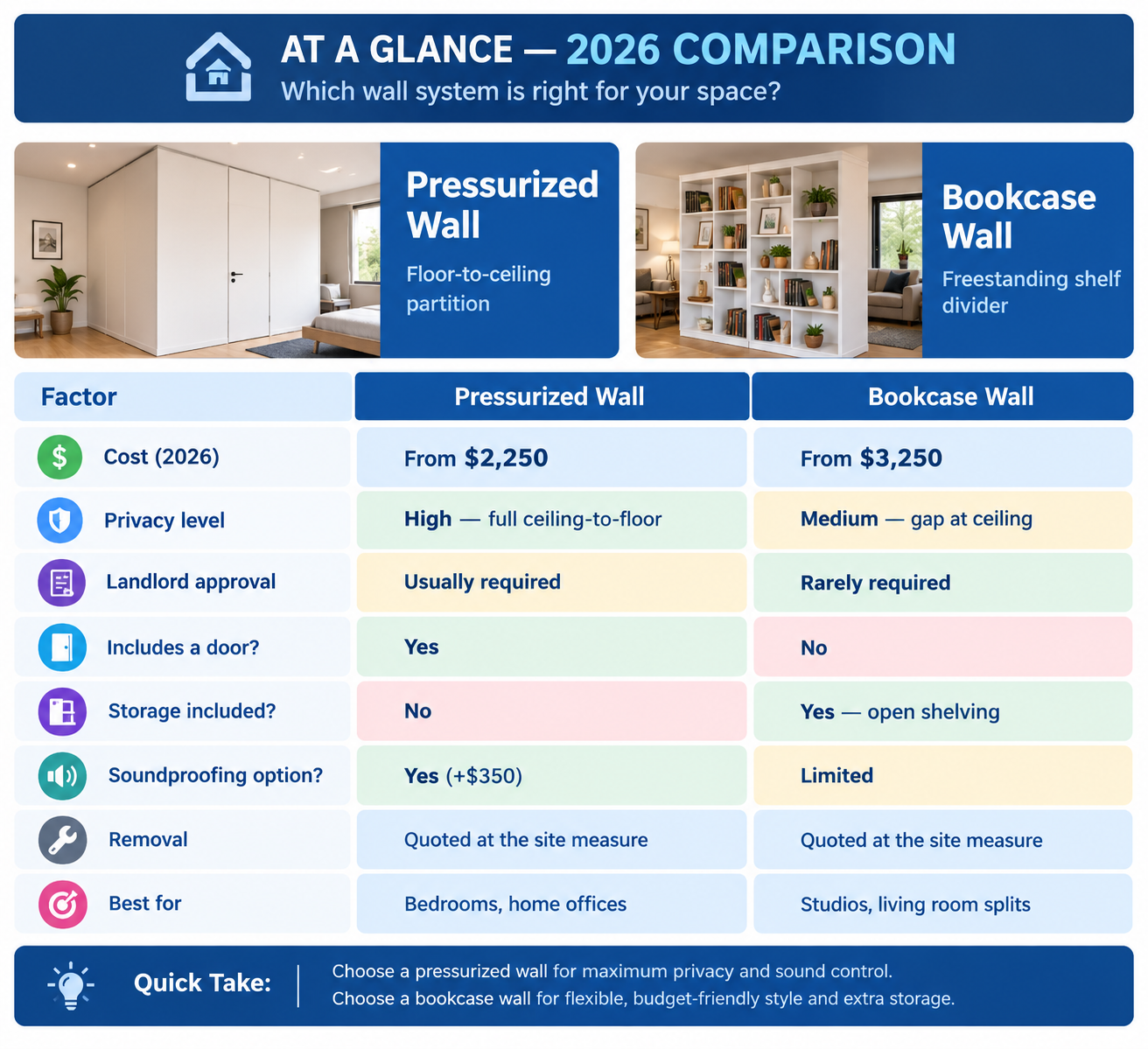
The bookcase wall vs pressurized wall NYC decision comes down to two things: how much privacy you need and whether your landlord will approve a floor-to-ceiling wall. A pressurized wall starts from $2,250. A bookcase wall starts from $3,250 and gives you privacy plus storage — and rarely needs landlord sign-off.
We've installed both types in over 5,000 NYC apartments. Here's the honest comparison so you can make the right call before you book anything.
AT A GLANCE — 2026 COMPARISON
| Factor | Pressurized Wall | Bookcase Wall |
|---|---|---|
| Cost (2026) | From $2,250 | From $3,250 |
| Privacy level | High — full ceiling-to-floor | Medium — gap at ceiling |
| Landlord approval | Usually required | Rarely required |
| Includes a door? | Yes | No |
| Storage included? | No | Yes — open shelving |
| Soundproofing option? | Yes (+$350) | Limited |
| Removal | Quoted at the site measure | Quoted at the site measure |
| Best for | Bedrooms, home offices | Studios, living room splits |
What Is a Pressurized Wall in NYC?
A pressurized wall is a floor-to-ceiling partition. It uses internal pressure to lock firmly between your ceiling and floor. There are no screws, nails, or adhesives. It looks like a real drywall wall. And it includes a door.
In NYC, pressurized walls go by many names. You'll hear them called flex walls, T-walls, or temporary walls. They are the same thing. Most renters use them to split a studio into a one-bedroom, or to add a second room in a large open-plan apartment.
Installation takes one day. A pressurized wall starts from $2,250 — that covers an 8 ft ceiling, a standard swing door, and up to 12 ft of width. Add soundproofing for +$350, a popular option for home offices in Midtown and SOHO lofts.
The wall comes out just as cleanly as it went in. No holes. No scuffs. No deposit risk.
What Is a Bookcase Wall in NYC?
A bookcase wall is a modular, freestanding shelf unit. It acts as a room divider. It does not reach the ceiling. It has no door. But it adds storage — which matters a lot in a 450-square-foot Brooklyn studio.
A professionally installed bookcase wall starts from $3,250. It is not the same as a DIY BILLY bookcase wall hack you'll find on Instagram. Those units are unstable, often unsafe, and tend to fail landlord inspections. A professional installation is built to your exact room dimensions, finished cleanly on both sides, and designed to look intentional.
Moreover, bookcase walls are freestanding furniture. That means, in most NYC apartments, you do not need landlord approval to install one. This makes them the top alternative when a co-op board on the Upper East Side or a Midtown building manager says no to a pressurized wall.
Cost: Bookcase Wall vs Pressurized Wall NYC
Both prices are floors, not ranges — the final quote depends on size, door type, and add-ons like soundproofing.
A pressurized wall starts from $2,250. That's an 8 ft ceiling, a standard swing door, and up to 12 ft wide. A taller ceiling, a French door, or soundproofing adds to that floor — never subtracts from it.
A bookcase wall starts from $3,250. It includes built-in storage — something a pressurized wall does not. So if storage was something you were going to spend money on anyway, a bookcase wall can be more cost-effective overall.
No leases, no hidden fees. Add-ons like soundproofing or extra height are quoted upfront, so you know your full price before we start. Removal is quoted at the site measure.
💰 Full 2026 Cost Breakdown: Pressurized Walls in NYC Every price variable — size, door type, soundproofing — with real 2026 numbers.Which Gives More Privacy?
A pressurized wall wins on privacy. It goes from floor to ceiling. It includes a door. Sound and light do not pass through. With soundproofing added, it performs close to a standard drywall partition.
A bookcase wall, on the other hand, stops short of the ceiling. There is always a gap at the top. Sound travels through that gap. Light passes through the shelves. It creates visual privacy — but not acoustic privacy.
Therefore, if you need a real bedroom — especially one you plan to list on a roommate app or Craigslist — a pressurized wall is the right choice. A bookcase wall works well as a studio divider. It creates the sense of a separate living area. But it is not a true bedroom.
For home offices in Flatbush or Jackson Heights, a bookcase wall often works fine. Zoom calls don't need the same sound isolation as a full-time bedroom. However, if you're working from home with a partner or roommate and need real quiet, go with the pressurized wall plus soundproofing.
Landlord Approval: The Real Difference Between the Two
This is where most people make their final decision.
A pressurized wall requires landlord approval in most buildings. Most standard rental landlords in Brooklyn, Queens, and the Bronx say yes quickly. However, co-op boards on the Upper West Side and pre-war buildings on the Upper East Side are more likely to push back. Some say no outright.
A bookcase wall, in contrast, is treated as furniture. Most NYC leases do not require approval for furniture — even large, floor-to-near-ceiling furniture. As a result, a bookcase wall is the default choice when a landlord has refused a pressurized wall or when you don't want to have the conversation at all.
Which Is Easier to Remove? (The Deposit Question)
Both types are easy to remove. Neither damages the apartment. Neither puts your deposit at risk.
A pressurized wall uses pressure — not screws or adhesive. When the pressure is released, the panels come apart and are carried out. The floor and ceiling are left clean. Removal is quoted at the site measure.
A bookcase wall is freestanding. It disassembles the same way it went together and leaves no marks. Removal is quoted at the site measure, same as a pressurized wall.
The deposit question is more about documentation than the wall type. Take timestamped photos of your ceiling and floor before installation. Take photos again after removal. That protects you if a landlord in Crown Heights or Astoria tries to attribute pre-existing marks to the wall.
Ready to get a quote for your specific space?
We install both types across Manhattan, Brooklyn, Queens, the Bronx, and Hoboken.
Call or text — most clients get a price within the hour
Get Your Free Same-Day Quote →Bookcase Wall vs Pressurized Wall NYC: Which One Should You Get?
Here is the simple decision guide. Use the answer that fits your situation.
Get a Pressurized Wall If:
- › You need a true bedroom — one a roommate will pay real rent for
- › You need a door — for work calls, sleeping hours, or personal space
- › You want soundproofing for noise control
- › Your landlord has already said yes — or you're in a standard rental in Brooklyn, Queens, or the Bronx
Get a Bookcase Wall If:
- › Your landlord or co-op board has refused a pressurized wall
- › You want extra storage in a small apartment
- › You want a visual divider — not a full bedroom
- › You're in a co-op on the Upper East Side or Upper West Side and don't want the board conversation
What NYC Renters in Brooklyn, Queens & Manhattan Actually Choose
Based on our 5,000+ installations, here is what renters in each borough most often choose and why.
Brooklyn renters — Crown Heights, Bushwick, Flatbush — overwhelmingly choose pressurized walls. Landlords in these neighborhoods approve quickly. The apartments are larger. And renters are splitting rent with a roommate, so a true bedroom with a door is non-negotiable.
Manhattan renters — especially in co-ops on the Upper West Side and Upper East Side — split fairly evenly. Those who get approval go with pressurized. Those who don't go with bookcase. In SOHO lofts, pressurized walls with high-ceiling installs are the most common. They work well with the open-plan layout.
Queens renters — Astoria, Jackson Heights, Flushing — mostly choose pressurized walls. Landlords in these areas are generally cooperative. Bookcase walls come up most often in larger studios where the renter wants to create a reading nook or a defined workspace — not a full second room.
Bronx and Hoboken renters choose pressurized walls at a higher rate than the city average. Apartments in these areas are often larger, and the cost per square foot of space created makes a pressurized wall the better financial decision.
If you want a broader overview of all temporary wall types — including partial walls — StreetEasy's guide to temporary walls covers how building managers across NYC think about each type, which is useful context before you approach your landlord.
Frequently Asked Questions
What is the difference between a bookcase wall and a pressurized wall in NYC?
A pressurized wall is a full floor-to-ceiling partition with a door. It uses pressure — not screws — to stay in place. A bookcase wall is a freestanding shelf unit that divides a room. It does not reach the ceiling and has no door. Pressurized walls give more privacy. Bookcase walls give more storage and rarely need landlord approval.
How much does a bookcase wall cost in NYC in 2026?
A bookcase wall in NYC starts from $3,250. The final price depends on size, number of shelving panels, and finish. A standard pressurized wall starts from $2,250. Bookcase walls include built-in storage, which adds value for small apartments.
Do I need landlord approval for a bookcase wall in NYC?
In most cases, no. Bookcase walls are freestanding furniture. Most NYC leases do not require approval for furniture. This makes them the go-to option when a landlord or co-op board has refused a pressurized wall. That said, always check your specific lease — some newer buildings have broad alteration clauses.
Which gives more privacy — a bookcase wall or a pressurized wall?
A pressurized wall gives more privacy. It reaches the ceiling, includes a door, and can be soundproofed. A bookcase wall leaves a gap at the top that lets sound and light through. For a true bedroom, choose a pressurized wall. For a studio divider or home office separation, a bookcase wall often works fine.
Can I install a BILLY bookcase wall in my NYC apartment?
You can, but a DIY BILLY bookcase hack is not the same as a professional installation. DIY units are unstable and tend to fail landlord inspections. A professional bookcase wall is built to your exact dimensions, finished on both sides, and designed to last.
Which is easier to remove — a bookcase wall or a pressurized wall?
Both are easy to remove and leave no damage. Neither uses screws or adhesive in the walls, floor, or ceiling. Removal is quoted at the site measure for either type. Document your surfaces with timestamped photos before installation and after removal — that protects your deposit regardless of which type you choose.
Related Articles
🧭 Temporary Walls NYC Comparison: Pressurized vs Flex vs Bookcase All three wall types side by side — price, privacy, storage, and landlord approval odds. 📖 Pressurized Walls NYC: The Complete 2026 Guide Cost, types, legality, and landlord approval — everything in one place. ⚖️ Are Pressurized Walls Legal in NYC? What the Rules Actually Say in 2026 Egress, co-op approval, DOB rules — the honest legal picture. 🔧 Temporary Wall Removal in NYC: What It Costs & When to Schedule Removal is quoted at the site measure. What move-out day actually looks like. 💰 How Much Does a Pressurized Wall Cost in NYC? (2026 Pricing) Full breakdown by size, door type, and soundproofing — with real 2026 numbers.Not Sure Which Wall Fits Your Space?
We've installed both types in apartments from Crown Heights to SOHO to Astoria. Tell us your room dimensions and what you need — we'll tell you exactly which wall makes sense and what it'll cost.
Call or text — most clients get a same-day quote
Get Your Free Quote →Donny has installed pressurized and bookcase walls in NYC apartments for 15+ years. Over 5,000 installations across Manhattan, Brooklyn, Queens, the Bronx, and Hoboken. He's heard every landlord objection, worked in every building type, and knows exactly which wall makes sense for which situation. He started the company because he needed a way to afford this city himself.