
By Donny Zanger · Published · Last updated: · 13 min read
Temporary Walls NYC Comparison: 3 Types Ranked
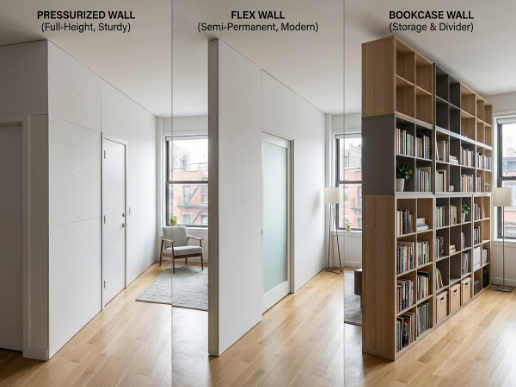
Three types of temporary walls get installed in NYC apartments every week: pressurized, flex, and bookcase. This temporary walls NYC comparison breaks down what each one actually costs and does, starting with the honest version of the numbers: pressurized and flex walls are the same build at the same price, from $2,250 with a standard swing door included, and bookcase walls start higher, from $3,250, in exchange for skipping the landlord conversation entirely. If you're trying to split a one-bedroom in Bushwick with a roommate, or your co-op board on the Upper West Side just said no to a floor-to-ceiling wall, the type you pick matters more than most renters realize. We've installed all three more than 5,000 times across every borough. This guide skips the theory and gets straight to the trade-offs: price, privacy, storage, and which one your landlord is actually likely to approve.
Not sure which wall fits your apartment?
Call +1 646-569-9975. We'll walk you through it in five minutes.
Call +1 646-569-9975Quick Answer
Pressurized wall: From $2,250. Floor to ceiling. Includes a door. Best privacy and sound blocking.
Flex wall: From $2,250. Same build and price as pressurized — a different name for the same product, not a separate finish tier.
Bookcase wall: From $3,250. Stops short of the ceiling. Adds storage. Usually skips landlord approval.
Worried Your Landlord Will Say No? Here's What Actually Happens
That's the real question behind almost every one of these calls. You've found the apartment. The layout works if you add a wall. The only thing standing between you and signing the lease is whether your landlord, or your co-op board, will let you.
Here's the honest answer. Pressurized and flex walls are legal in NYC when they meet building code requirements for egress, ventilation, and sprinkler clearance. Most standard rental landlords in Brooklyn, Queens, and the Bronx approve them without a fight. Co-op boards on the Upper East Side and in pre-war Manhattan buildings push back more often, mostly because a floor-to-ceiling wall changes the apartment's footprint in a way board members want to see in writing first.
Bookcase walls sidestep a lot of that friction. Because a bookcase wall is built and installed as freestanding furniture rather than an architectural change, most NYC leases don't require landlord approval for one at all. If your building has already said no to a pressurized wall, a bookcase wall is usually the fallback that gets you to yes.
We always recommend getting written approval from your landlord before installation, even when it isn't strictly required. It protects your deposit and it protects the relationship. What we won't tell you is that a permit is never required for any of these walls, because that depends on your specific building and project, or that your landlord will never notice. Neither claim holds up, and a company that tells you otherwise is setting you up for a problem at move-out.
For the full building-code breakdown, the NYC Department of Buildings publishes the egress and ventilation rules that govern any interior partition.
Pressurized Walls: The Standard NYC Choice
A pressurized wall is a floor-to-ceiling partition that locks between your ceiling and floor using internal pressure instead of nails, screws, or adhesive. Once it's up, it looks and functions like a real drywall wall, complete with a door. This is the wall most renters mean when they say "temporary wall" without specifying further.
Pricing starts from $2,250, which already includes a standard swing door, up to 12 feet wide and an 8-foot ceiling. From there, real upgrades are priced separately: a French door adds $450, a pocket sliding door adds $300, a pocket French door adds $750. A 9-foot ceiling adds $250, a 10-foot ceiling adds $500. Extra width beyond 12 feet adds $190 per foot. Soundproofing is a flat $350 on top of any of that.
What you get for that money is real privacy. Sound and light don't pass through a pressurized wall the way they do through a bookcase wall's open shelving. If you're creating a bedroom you plan to list on a roommate app, or you just need a door you can close at 11 p.m. after a long day, this is the type built for that.
The trade-off is timeline and reversibility expectations. Installation still takes one day, four to eight hours in most apartments, and removal is quoted at the site measure when your lease ends. But because it's a true floor-to-ceiling structure, it's the option most likely to need a landlord conversation first.
For a full walkthrough of the process and pricing variables, see our pressurized wall installation guide.
Flex Walls: Same Wall, Different Name
Here's the straight answer, because renters searching both terms deserve it: a flex wall and a pressurized wall are the same build, at the same price, from the same $2,250 floor. "Flex wall" and "pressurized wall" are two names for the same pressure-fit technology — not a budget option and a premium option. If a search result or another company implies flex walls cost more for a nicer finish, that's not how we price them, and it's not how the underlying product differs either.
So why do both terms exist? Mostly because renters search for both, and both searches deserve a straight answer rather than being redirected without explanation. If you've read this far wondering whether you need to choose between "flex" and "pressurized" for your own apartment, the answer is: you don't. Pick whichever term matches how you were searching — the wall, the price, and the installation process are identical either way.
We break this down in more detail in our flex wall vs. pressurized wall guide.
Bookcase Walls: Storage Plus Privacy, No Landlord Fight
A bookcase wall divides a room the same way a pressurized wall does, except one side of the divider holds open shelving instead of finishing flush like a drywall panel. It's built as a freestanding piece of furniture, which is exactly why it rarely triggers a landlord approval process.
Pricing starts from $3,250 — the highest floor of the three wall types, since a bookcase wall is a more complex build than a straight partition. What you're paying for isn't a lower price; it's skipping the landlord conversation and getting built-in storage in the same job. In a Harlem studio or a Bronx one-bedroom where closet space is already tight, that built-in storage does real work.
The trade-off is at the top of the wall. A bookcase wall stops a few inches below the ceiling, so there's always a gap. Sound travels through that gap, and light passes through the open shelves. You get visual privacy, not acoustic privacy. That makes a bookcase wall a strong studio divider and a weaker choice if you're trying to create a bedroom for a roommate who works overnight shifts and sleeps during the day.
See our full bookcase wall vs. pressurized wall breakdown for a side-by-side on cost and privacy.
What About Room Dividers and Accordion Walls?
Two other terms come up in the same searches, so it's worth separating them out. A room divider, in the generic sense, usually means a curtain, screen, or freestanding panel that offers visual privacy only. It costs significantly less than any of the three walls above, since it's an off-the-shelf or low-cost product rather than a custom installation. But it doesn't reach the ceiling, doesn't block sound, and won't hold up to a landlord asking whether you've made a real change to the apartment. An accordion wall is a folding, track-mounted partition. It's more common in commercial buildouts and offices than residential apartments, since it needs a header track installed. It also doesn't offer the same finished look as a pressurized or bookcase wall. For a real bedroom or private office in an NYC apartment, the room-divider-vs-pressurized-wall comparison isn't close. A room divider is a stopgap, not a solution. Most renters who start there end up calling us within a few months anyway, once the lack of real privacy becomes a daily annoyance.
How Installation Day Actually Works
The process is the same across all three wall types, which is part of why the price difference comes down to materials and finish rather than labor complexity.
We measure. This can happen over the phone with your own dimensions, or with an in-person visit if the room has an unusual layout, an angled wall, or existing molding we need to work around.
We build and install. Materials are cut to your exact dimensions before the crew arrives, so the on-site work is assembly and fitting, not construction. Most installs finish in four to eight hours, and a single pressurized or flex wall rarely runs past one day even with a soundproofing add-on. Bookcase walls, since they're assembled as furniture, can sometimes go faster.
You move in. There's no drying time, no dust to clean up, and no waiting period before you can hang art, mount a TV, or push a bed frame against the new wall. A pressurized or flex wall supports light wall-mounted items once installed; check with your installer before mounting anything heavier than a shelf.
When it's time to move out, removal is quoted at the site measure on all three wall types. Because most NYC leases run on a similar annual cycle, removal requests cluster heavily in the weeks before common move-out dates. If you already know when your lease ends, booking your removal a few weeks ahead keeps you off the waitlist during the busiest stretch of the year.
A Real Example: Same Apartment, Two Real Answers
Picture a two-bedroom conversion in a Crown Heights brownstone, splitting the living room to create a third bedroom for a roommate. If the goal is a private bedroom with a real door, a pressurized wall (call it flex if that's the term you searched — same wall, same price) gets it done in a day. The landlord, a small independent owner rather than a board, approves it after a short phone call. Now picture the same apartment inside a managed building on the Upper West Side with a stricter co-op board. A bookcase wall gets the group into the space faster, since it skips the board approval process entirely — the pressurized-wall alternative would work through the board's timeline in the background instead.
Neither answer is wrong. They're optimized for different constraints: full privacy at the lower price, or a faster path to approval plus storage at the higher one. That's the whole decision in miniature.
Mixed households come up often, too. A four-bedroom share in Jackson Heights might end up with two pressurized walls for the bedrooms that need real doors. The living room might get a bookcase wall instead, dividing off a nook for a roommate who mostly needs a place to work from home. There's no rule that says every wall in an apartment has to match. We quote each one on its own, based on what that specific space needs.
Every quote we send breaks the price down by wall type and by room, so a mixed installation doesn't come as a surprise on the invoice.
Temporary Walls NYC Comparison Table: All Three Types Side by Side
Here's the full breakdown in one place. Pressurized and flex are listed separately since renters search both terms, but every row is identical between them — they're the same wall.
| Pressurized wall | Flex wall | Bookcase wall | |
|---|---|---|---|
| Price | From $2,250 | From $2,250 | From $3,250 |
| Reaches ceiling | Yes | Yes | No — gap at top |
| Door included | Yes, standard swing (upgrades available) | Yes, standard swing (upgrades available) | No — open access |
| Sound blocking | Strong | Strong | Weak |
| Built-in storage | No | No | Yes |
| Landlord approval typically needed | Yes | Yes | Usually not |
Want the exact number for your apartment? Tell us your room dimensions and we'll send a price before end of day.
Call +1 646-569-9975Which One Should You Get?
We'll make the call instead of leaving you to guess, because that's what fifteen years of doing this is for.
If privacy is the deciding factor, meaning you need a real bedroom door and you don't want sound leaking through, get a pressurized wall — call it flex if that's what you searched, it's the same wall at the same price. It's the cheaper of the two floors, and it gives you full floor-to-ceiling separation with a real door.
If your landlord already said no to a floor-to-ceiling wall, or you know your building is strict, go with a bookcase wall before you spend time fighting that battle. It starts $1,000 higher than a pressurized wall, but you're paying for skipping the approval process entirely, plus built-in storage. You'll still get privacy from a casual glance.
If storage is genuinely your bigger problem, meaning your apartment doesn't have enough closet or shelf space regardless of the wall question, the bookcase wall is worth the higher floor even in buildings that would approve a pressurized wall without issue.
Most NYC renters end up choosing between a pressurized wall and a bookcase wall. Those two cover the two real priorities: full privacy at the lower price, or easier approval plus storage at the higher one. "Flex wall" isn't a third option — it's the same product as pressurized, so whichever term you search, you'll land on the same wall.
What About Soundproofing?
All three wall types can add soundproofing, typically mineral wool insulation, for a flat $350. This closes most of the remaining sound gap on a pressurized or flex wall and gets you close to what a standard interior apartment wall blocks. On a bookcase wall, soundproofing helps less, since the open shelving at the top still lets sound through no matter what's inside the wall itself. If acoustic privacy is your main concern, put the soundproofing budget toward a pressurized or flex wall instead of a bookcase wall.
Frequently Asked Questions
Which is cheaper, a pressurized wall or a bookcase wall?
A pressurized wall, starting from $2,250. A bookcase wall starts from $3,250 — $1,000 higher — because it's a more complex build. The bookcase wall's price covers skipping the landlord approval process and getting built-in storage, not a lower cost.
Do I need landlord approval for a bookcase wall?
No, in most standard NYC leases. Because a bookcase wall is installed as freestanding furniture rather than an architectural change, it typically doesn't require the same landlord sign-off a floor-to-ceiling pressurized or flex wall does. We still recommend telling your landlord before installation.
What's the actual difference between a flex wall and a pressurized wall?
None. They're the same pressure-fit build at the same price, from $2,250. "Flex wall" and "pressurized wall" are two names renters search for the same product — not a budget tier and a premium tier.
Are temporary walls legal in NYC?
Yes, pressurized, flex, and bookcase walls are all legal in NYC when they meet building code requirements for egress, ventilation, and sprinkler clearance. Co-op and condo boards can still set their own approval process on top of that, separate from city code.
How long does installation take for each type?
All three types are typically installed in one day, usually four to eight hours depending on wall size and finish level. Removal is quoted at the site measure for every type and leaves no damage to floors, ceilings, or walls.
Can I combine wall types, like a bookcase wall for one room and a pressurized wall for another?
Yes. Plenty of NYC apartments end up with a mix, especially in larger shares where one bedroom needs full acoustic privacy and another is more of a home-office nook where storage matters more than soundproofing. We quote each wall separately, so there's no penalty for mixing types in the same apartment.
Will a temporary wall lower my apartment's resale or rental value when I move out?
No, as long as removal is done properly. Because all three wall types are designed to come down without damaging the underlying floors, ceilings, or walls, the apartment returns to its original layout. That's the entire point of choosing a temporary wall over a permanent renovation in the first place.
Ready to Pick the Right Wall for Your Apartment?
You've got the trade-offs now: pressurized (or flex — same wall) for privacy at the lower price, bookcase for storage and an easier approval process at the higher one. If you're still not sure which one fits your specific layout, that's exactly what a same-day quote is for. Tell us your room dimensions and your building type, and we'll tell you which wall makes sense before you spend another night scrolling Zillow.
Call +1 646-569-9975 for a free same-day quote. Most clients get a price within the hour.
Call +1 646-569-9975 Get a Free QuoteAbout the Author: Donny Zanger
Donny Zanger has installed more than 5,000 temporary walls across Manhattan, Brooklyn, Queens, the Bronx, and Staten Island over more than 15 years. He founded Pressurized Walls NYC to give renters a straight answer on cost, legality, and which wall type actually fits their apartment.